About Stable Future
The people and thinking behind the advice.
Who we are

Stable Future was founded by Ben Grime, an AI consultant based in the UK with a BA in Maths and Philosophy and an MSc in Data Science.
After two years as an AI Engineer, Ben left to work on the problems society will face in the AI era.
Work in the AI Era
Tech companies are in a trillion-dollar arms race to build artificial general intelligence (AGI): an autonomous system capable of automating almost all work. Whoever gets there will gain trillions more.
There are strong reasons to believe this is achievable. There has been rapid and exponential progress in AI’s ability to:
- Complete work across various sectors.
- Automate complex software engineering tasks.
- Solve frontier maths problems.
- Automate remote labour, with significant progress occurring in months, not years.
- Use computers for real-world tasks.
- Beat humans at forecasting global events.
- Out-persuade expert humans.
And many more.
The Intelligence Curse
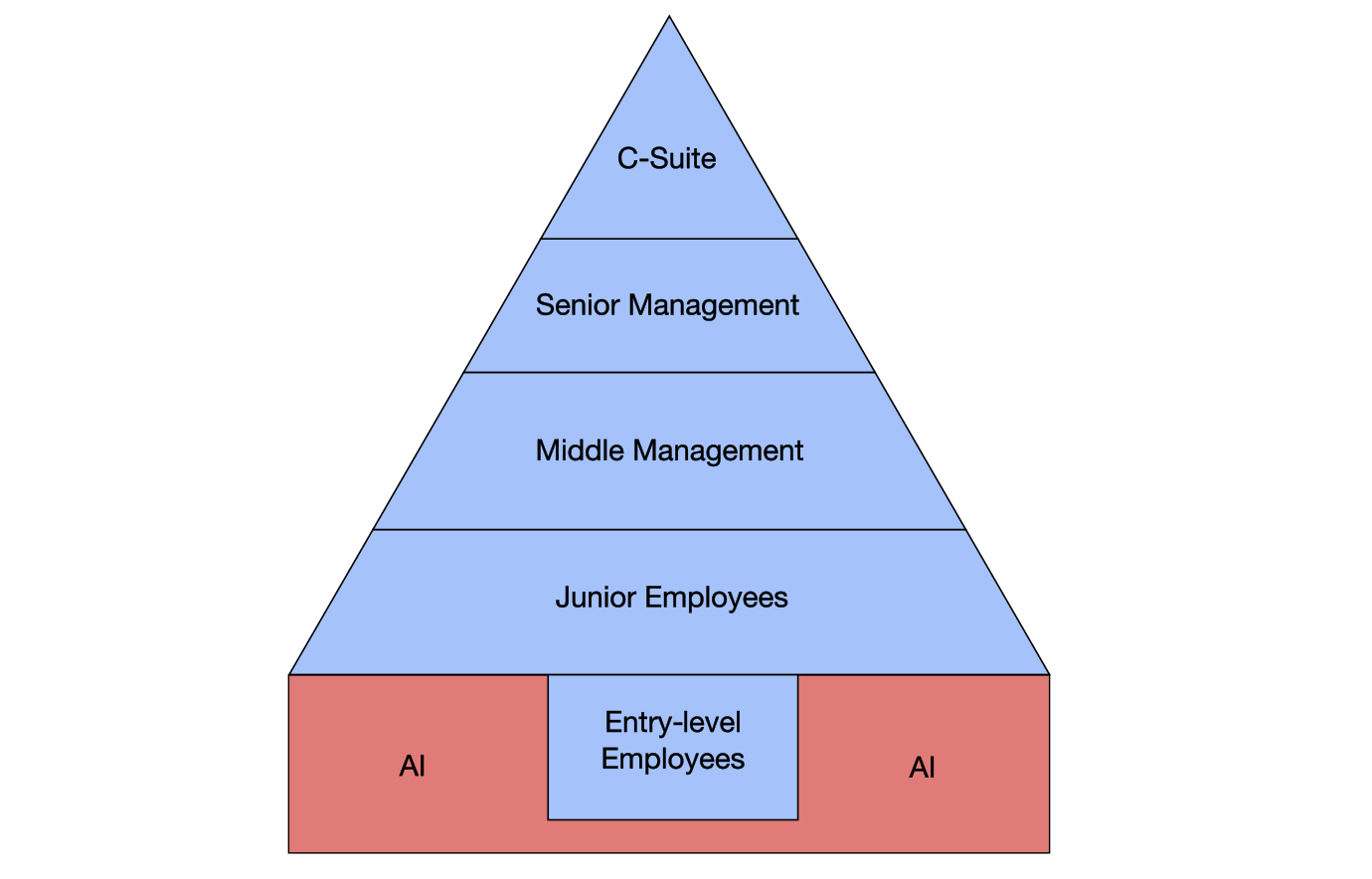
In The Intelligence Curse, Luke Drago and Rudolf Laine depict how this automation could play out:
- Powerful AI will push automation through existing organisations, starting with entry-level hiring freezes and moving upwards.
- AI will outcompete even elite talent, ending social mobility and the progress it drives.
- Non-human factors of production (like capital, resources, and control over AI) will become overwhelmingly more important than humans.
- This disincentivises powerful actors around the world (like governments or leaders of organisations) to care about humans as they are no longer required for productivity.
- This could result in the disempowerment of the vast majority of humanity.
Stage 1 is already underway, but the later stages are not an inevitability. They would unfold over the coming decades. To put it mildly, we’d quite like to prevent this from happening.
A Solution to Disempowerment
Whilst AI’s capabilities are progressing exponentially in some domains, progress remains slow in others. We call this jagged intelligence. Whilst they might be superintelligent coders, AI still can’t reliably tell the time. And even when AI catches up to humans at reading clocks or other niche tasks, it’s often only because once a failure becomes a viral meme, it becomes a target to train for.
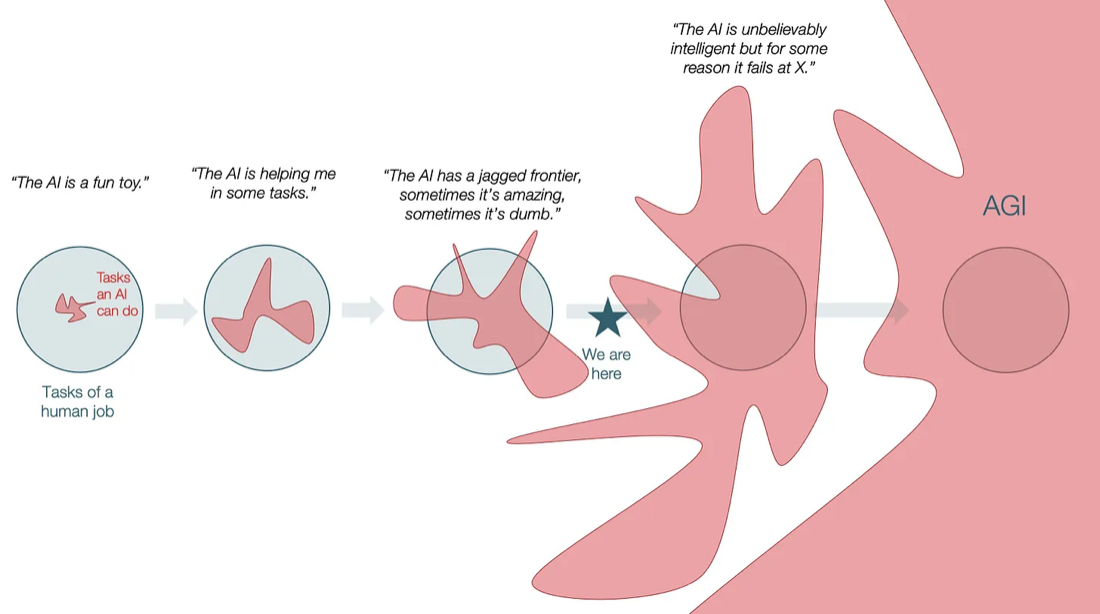
Which brings us to our final trillion-dollar question: which tasks will AI struggle with not just now, but in the future? As always, the answer lies in the data.
For AI to become human-level in any given domain, it needs to learn from good data. This is known as Reinforcement Learning (RL). All this means is:
- Show the AI model a problem, like a maths problem.
- Ask it to solve the problem and compare its answer with the real one.
- If the answer is correct, reward the model so it’s more likely to produce that answer next time (reinforce the learning).
- Repeat.
For example, AI will struggle with care work because it’s a messy domain; it’s hard to measure what good care work is, hard to convert that into the raw data required for rewarding the model, and very expensive to collect the data even if you wanted to (you need Human Feedback, RLHF). Compare this to software development, a highly structured and digital domain; code itself is data, there’s loads of it, AI can generate more of it at near-zero cost, and performance is easy to measure (it either runs or it doesn’t, and the fewer lines of code the better, so the Rewards are already Verifiable, RLVR, with no human needed).
This variance in available training data creates differing capabilities. In reality, the “jagged frontier” looks something like this:
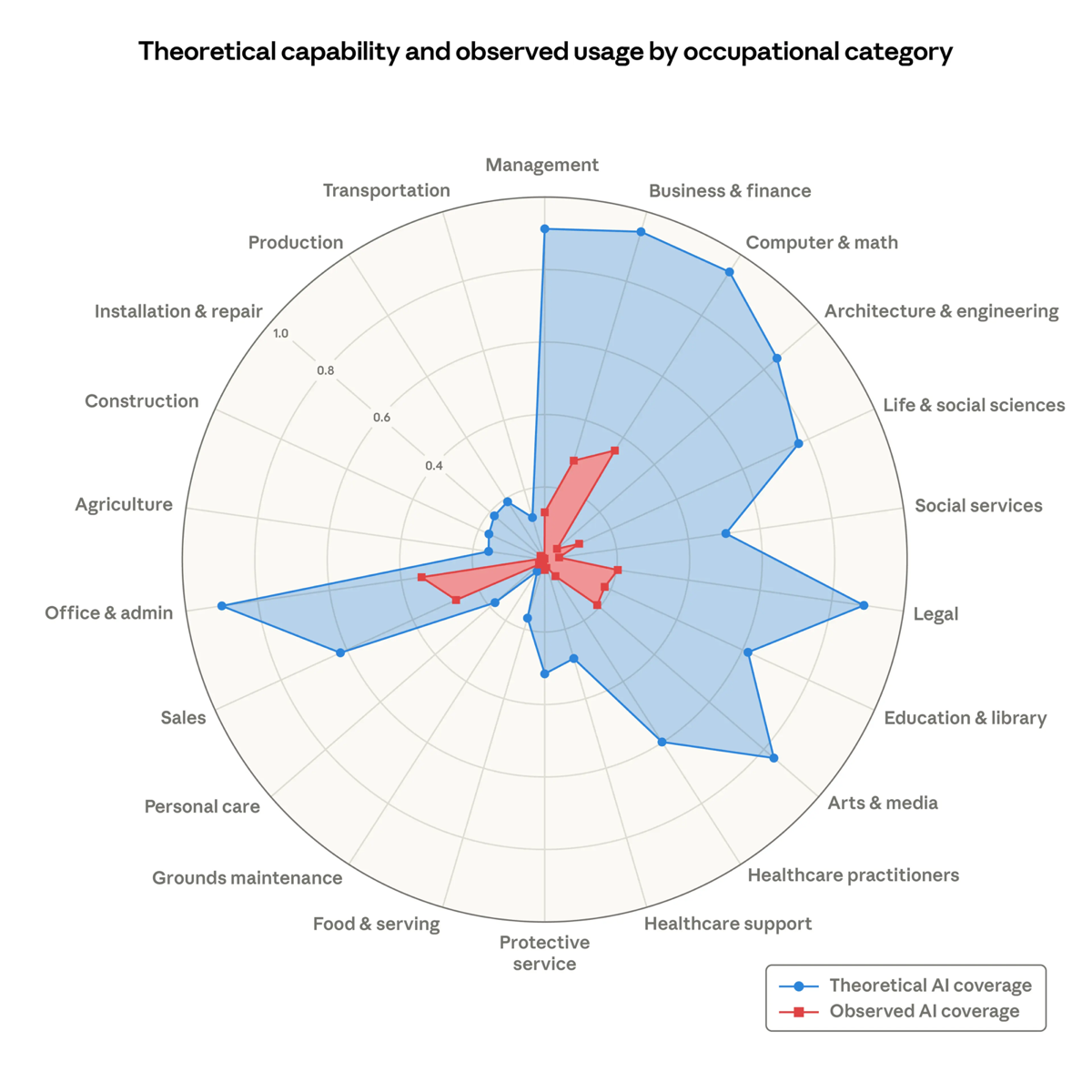
As AI expands into the contours of verifiable domains, we can remain economically empowered in two ways.
- Go where AI can’t (i.e. jobs that resist the reinforcement learning required to train AI).
- Go where humans using AI beat AI on its own (i.e. jobs that resist substitution by AI).
This creates our two key measures: AI Learnability and AI substitution.
- Surgeons are low learnability, low AI substitution.
- Accountants are high learnability, high AI substitution: we won’t need junior accountants much longer.